

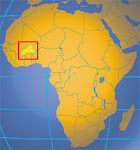


Much like my first impressions blog entry of my host village and first arriving in Burkina Faso, I'm doing it again and doing my first month's first impressions at site! So get ready for another long and detailed blog entry. Let's go!!
- Food: The first on my first impressions list...and rightfully so. I love food! But I'm happy to say that since moving to site, my food cravings have gone down significantly. Why? Because I'm able to choose (for the most part) what I can eat and when, and not follow a regimented schedule. As I mentioned before, I got the chance to shop at a legit supermarket in Ouaga so I stocked up on some necessities but really, I'm just happy I get to eat what I want. I'm fortunate enough to have a market nearby where I can get bread, tomatoes, onions, garlic, eggs, etc. etc. on a daily basis. To cook, I have a two-burner camping-like stove and a gas tank. Fortunately, I got a lot of the spices that the old volunteer left for me and have been cooking really basic things since I can't cook for shit. Lots of soups (despite the heat), sandwiches, pasta with different sauces, etc. But I think I'll slowly perfect a knack for cooking! The next time I get Internet access, I'll be posting this HUGE list of food I miss from home (I made it during training). It's gonna be epic!
- People/Neighbors: During site visit, I said the people in my site seemed a little more distant and reserved but I can honestly say that's the opposite. Living at site for a month has made me realize I'm meeting some really amazing people that have some of the kindest hearts -- you just gotta dig deep a little bit and be open to laugh at/enjoy the experience at-hand. I live in a fonctionnaire (civil servant/teacher) house so many of my neighbors are very much in the middle-class here in BF. Very hospitable and I tend to causer (chat) with them every once in a while over African tea -- 3 small cups is the tradition, getting sweeter with every cup. In any case, it's interesting because most of the people I've met have been men or boys. The only time I've really met women and girls is at the water pump, which is why I don't want to get someone to pump my water for me regardless of how physically tiring it might be! One kid that's helped me so much is this 15 year old teen boy named Ali but secretly (not so secretly anymore), I call him Nelson Mandela. Really! Not only does he look like a younger Nelson Mandela but he also just helps me out with everything. I guess everyone has that one person that helps you out and that person for me is him. He'll come and help me cook, and when you're living by yourself, it's nice to share a meal with someone. Ali also has this aura of someone that's wise beyond his years -- so mature and I'm just so impressed with how this boy was raised!
 World, meet Ali. Or as I refer to him: a younger Nelson Mandela. This was one night when he came over for dinner and I cooked pasta with a homemade cream sauce. Which was good for a few bites until I realized how horribly fattening and bad it was for you. But all is well -- I'm still alive!
- My house: What was once a house filled with some cobwebs and things that weren't my own is now a home that's truly MY own! I took the first week or so to decorate my house, clean EVERYTHING and re-arrange the furniture like crazy. I live in a concrete house which is much different from what I'd been living in for training (a hut). I have an outdoor latrine and bucket bath area, an outdoor kitchen if I were to ever cook with wood, 2 small walls to enclose my courtyard, an elevated porch, a main living room with a kitchen area and 2 adjoining bedrooms. In short, this house is freakin' huge for someone like me, living by himself, in BF! I've decorated my walls with pagnes (African fabric) since I'm too lazy to paint. Although I do want to paint quotes on my wall, etc. So we'll see -- keep your eyes peeled for a blog entry in the coming months that gives you all a little tour of my house!
- The town life: In BF, you live in a village, a town or a city. A city is more like Ouaga or Bobo -- electricity generally in all houses and pretty much has the luxuries of any developed city in the world. A town can vary greatly but usually means easy access to the paved road, boutiques/magasins (stores), a regular if not daily market, and some electricity throughout. A village is much like what you'd imagine -- very traditional, small, and usually far from the paved road. During training, I lived in a village and whenever I get on the Internet, I'm usually in a city like Ouahigouya or Ouaga (the capital). But my site is more of a town -- I don't have running water or electricity but I'm so close to the paved road, near many stores and a market, etc. On that note, I feel like I live far enough from the paved road that I can't hear the motos or cars and buses pass by. You all should come visit some time!
- Daily routine & pace of life (U.S. vs. Training vs. Site): In the U.S., I would wake up early in the morning, do the usual routine, sit in traffic, take BART (Bay Area's version of the metro/subway), head to work in SF, do the usual thing, head home, perhaps go out with friends/co-workers, go on the Internet, watch some TV, and then go to sleep. Same routine all the time. During training, it was a lot of biking, a lot of sitting in sessions, sweating like no other and such. At site...well, for the first 3 months until our In-Service Training (IST) in December, we're supposed to meet people and integrate with our communities. Which basically means a lot of sitting around and reading after you've met how many people! Let's just say there's no set schedule and I hope I don't go crazy. Good thing is that school starts very soon so I can start meeting teachers & students, and observe classes! Generally speaking, the pace of life is completely different. Everyone in the U.S. has a "go-go-go" mentality to always get something accomplished. Here in BF, not so much. In fact, not at all. Taking your time, showing up casually late to events, not being in any rush to get anything accomplished -- that's all part of the life here, and something that many Peace Corps Volunteers have to accept and struggle with everyday. I sure do.
- Weather: WOW. So to give you an idea of the geography of BF, it's a landlocked country. The north borders the Sahara Desert so it can get pretty damn hot. Our 3 months of training took place in Ouahigouya (the North) where there was this really dry heat. The landscape reflected that with few trees and lots of sand and red dirt. Compare it to where my site is now -- the Southwest, where there is greenery and hills EVERYWHERE. There are even a couple small barrages (small dams) where people go fishing! However, the heat gets humid which personally, I think is worse than dry heat. But generally, the temperature is cooler and a little more bearable compared to the North. The month of September, it poured almost every day which was amazing. I used to be scared of sleeping when it would rain because when it hit my tin roof, it sounded like the end of the world was coming! Now, I've gotten used to it and sleep like a baby. Sadly, I heard a mini-hot season is upon is which sounds like no fun. SO we'll see!
- Language: Let me first say that my French classes from high school and college have helped me survive and then some. No lie. So to Mme. Ratajczak, Mme. Mahoney, Véronique, M. Lony et Dominique (my passionate French teachers/professors) -- I salute and thank you. Merci mille fois. Really! As for local language, that's a different story. Because BF is composed of many, many ethnic groups that have languages with no similarities at all, it's interesting making conversations with those who don't speak French. More so, in the Southwest where I live, I have neighbors that not only speak Lobiri, but also Dioula/Jula, Mooré, Fulfulde and perhaps a few others! So I've decided to narrow it down to two and find myself a tutor soon to train me in these two local languages (Lobiri and Dioula/Jula) to facilitate better integration into my community.
- Transportation: Great but LONG. While I'm happy my site is right on the goudron (paved road) and that I'm the last stop south of Ouaga, the bus ride is long. 7 hours, man! In a hot bus where people, for some reason, don't like to open windows when there's no air-conditioning whatsoever and it's blazing hot inside. But I can't complain because I've made good friends with the people that work at my bus station so all is well! Now that I'm at site, I rarely use my bike and actually prefer to walk around instead (unless I want to get something quickly without saluer [greeting people] dozens of people). So walking and taking the bus are my main modes of transport.
- Communication: I have a PO Box that I share with other volunteers near my provincial capital. Check out the link to my address and package wish list! I also have a cell phone so if we're friends on Facebook, you can find it there! I don't get charged for receiving phone calls or texts but you better believe it's expensive as hell for me to call and even send texts! As you know, I don't have Internet access unless I'm here in Ouaga (the capital). I heard there are Internet cafes in my provincial capital but are so slow it's probably not even worth going (unless you enjoy sitting at an Internet cafe for 2-3 hours, waiting for your e-mail inbox to load. No joke.). We'll see as I make more trips to Gaoua.
- The Loneliness Factor: Or as I've read in our Health Manual, "the lonely but never alone" syndrome. Going from training where you're with Americans 24/7 to being dropped off at your site, BY YOURSELF, in a culture you're not too familiar with well...it kinda sucks and by default, you get a little lonely. Okay, I lie. You don't get a little lonely. You get VERY, VERY lonely. "The lonely but never alone" syndrome, however, astutely describes this. While I get visitors frequently, there's a cultural and language barrier to get over. Even if I took French in high school and college, I still have to focus and pay attention (you get what I mean?). It's something I'll always be battling, regardless of how integrated I am with the community. HOWEVER, one solution is getting a dog. YES, a dog. Which I should be getting very soon. Yes!
- Cultural Mannerisms I've acquired: First off, I almost always say, "mmmm-hmm," "voilà," or "ou bien" after everything I say. I saluer (greet) random people all the time, as is the custom here in Burkina Faso. And it's not just saying hi...it's asking about their family, how work is going, their day/night, etc. I'm sure there are many more.
- My perceptions of me as an "American" or otherwise...: "CHINOIS." "JAPONAIS." The two words I hear the most whenever I walk by or people are talking about me in their local language while I'm at a store or whatnot. I always make it a point to correct them -- not to be spiteful or mean but to genuinely let them know that I'm an American volunteer of the Peace Corps. That I'll be living in Burkina Faso for 2 years, working with the GEE program + starting other secondary projects, and that the reason I look Chinese/Japanese is that my parents came from the Philippines and immigrated to the U.S. So I'm really Filipino-American. If anything (and I say this all the time), if I left Burkina Faso now, at the very least, I've been able to change several dozen people's perceptions of Americans (third goal of the Peace Corps!). I've realized that my presence in Burkina Faso is interesting because I'm probably the first or one of the few Americans they've met in person. But really, I don't mind this at all and actually welcome exchanges like that because I get to meet new people.
- Personal Space/"Living in a Fishbowl" mentality: Seriously, I feel this now more than ever. It's funny because during training, everyone had personal space issues and I didn't. Now, I feel like I have many personal space issues but most especially, having the mentality of "living in a fishbowl" - of being watched all the time. I've set boundaries of when I'd like time to myself (I close my main door) and whatnot, so it's been getting better. But I feel like whenever I leave to travel somewhere (to my provincial capital, to visit other volunteers nearby or to go to Ouaga), I feel like I have to explain myself when I return because people ask me where I've been, etc. And the term cadeau (gift) is starting to become a term I despise because kids say it all the time whenever I return from travel.
- Things I take for granted: Electricity. I can honestly live without electricity (at least for these 2 years) but sometimes it'd be nice to have a light (that isn't by candles) in my house when it's pitch black outside (and inside). Or to charge my iPod whenever I'd like instead of waiting until I head to Ouaga. You know, the basics. Water. Fortunately, I'm not too far from the pump but it's a trek to get the empty plastic water jugs, pump the water, have people laugh at you/talk with you, then head back and store it. It makes me conserve so much water and I sometimes reuse water for certain things to save me from pumping so much damn water every 2 days. Trash. There is no trash system here. Everyone just litters and throws their trash everywhere. Sadly, I succumb to this sometimes but at home, I have a trash can and have to burn my trash or else the kids will go through it/it'll fly everywhere. Laundry. Wow, at first I didn't mind but now I question whether I wash my clothes thoroughly because of a little stench. As much as I want to do everything myself, I think this might be the one thing I'll pay someone to do for me because it's so damn tiring, especially if you have as many clothes as me!
- Initial perception vs. reality: I bring this up because my initial perception of how my life would be in Africa is completely different from the reality. I thought I would have no access to Internet, phones, and general communication, and would be completely isolated from the rest of the world/my family and friends back in the U.S. But really, while I don't have consistent Internet access, I do have a cell phone that has pretty good reception and have the conveniences of little stores nearby to buy basic food items and such. Also, transport...not as crazy as I thought it would be. I thought I'd be in those huge trucks, sitting in the back with hundreds of animals and people everywhere. One of my friends also mentioned the heat. I can say that I'm somewhat used to it but she (as well as I) really thought it would be so unbearable that it would affect our effectiveness as Volunteers. Which is still very possible since we haven't hit hot season yet from late February to May. I'm sure there are more, but it's just interesting to note these things, you know?
AND please write me letters/send packages and comment on this blog when you get the chance!!
